Online HR Toolkit
Get full access to 1000+ up-to-date HR guides, 24/7 Legal Helpline*, document templates, policies and guidance for you or your HR team




Get full access to 1000+ up-to-date HR guides, 24/7 Legal Helpline*, document templates, policies and guidance for you or your HR team

Metrics matter in every business, but recruitment metrics can be especially valuable for SMEs looking to stay competitive and keep hiring costs under control. In this blog, we explore why recruitment metrics are important, how they can support your recruitment strategy, and some of the key metrics worth tracking.
Recruitment metrics are used to measure hiring success and improve the process of attracting and securing top talent. They give organisations valuable data that can be used to strengthen recruitment strategies, improve efficiency and make better hiring decisions.
Making the right recruitment decisions is important for any organisation. Hiring someone who is well suited to the role can deliver significant return on investment (ROI).
Employee lifetime value (ELTV) refers to the total net value an employee brings to a business over time. The graph below illustrates this across the employee lifecycle. The X-axis represents time, from the employee’s start date to the day they leave, while the Y-axis shows employee output.
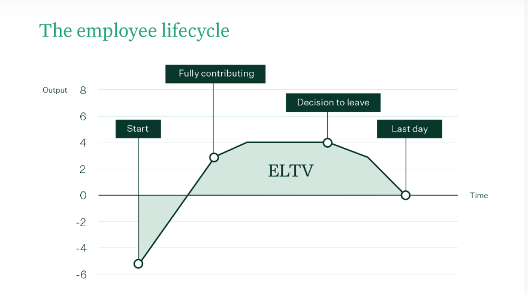
This type of data can be helpful when refining a company’s people strategy. From a recruitment perspective, employers want to make sure they are hiring the right candidates so they achieve a return on their recruitment investment. Hiring the wrong people can be costly, particularly if they leave before they are able to make a full contribution to the business.
A recruitment strategy is a plan that sets out how a business will attract and hire the right talent for its roles. It should take into account both current and future staffing needs, while aligning with wider business objectives and market conditions.
This includes defining the specific skills, behaviours and experience needed for each role, as well as preparing clear and accurate job descriptions.
Understanding the market is also essential. In a tight labour market, demand for skills is greater than supply, creating a candidate-driven environment. That is why it is important to have a clear strategy in place that identifies where talent can be found, which recruitment tools will be used, and how to deliver a positive candidate experience through clear and consistent communication.
There are many metrics that organisations can track, but it is important to focus on those that are most meaningful to the business and provide the information needed to improve recruitment processes. For small businesses in particular, hiring high-quality talent is crucial, as each employee can have a significant impact on overall performance.
Time to fill – this refers to the number of calendar days it takes to find and hire a new employee. It is often measured from the date a job opening is approved to the date a candidate accepts the offer. A number of factors can affect this metric, including market conditions, hiring manager availability and the type of role being recruited for. This data can help shape recruitment strategy. For example, if the figures suggest the market is tight because of a shortage of candidates, organisations can adapt their sourcing approach.
Time to hire – this measures the number of days between a candidate applying for a role and accepting the offer. In other words, it shows how long it takes a candidate to move through the hiring process. This is a useful metric because it can highlight bottlenecks in the recruitment process. Reviewing this by hiring team or manager can help identify delays and support improvements.
Source of hire – tracking where new hires come from is a popular and highly useful metric. It helps businesses understand how effective different recruitment channels are, such as job boards, LinkedIn, the company careers page, social media and recruitment agencies.
Sourcing channel effectiveness – this shows the percentage of candidates coming from a particular channel. It compares the percentage of applications received with the percentage of impressions a job advert has generated. Tools such as Google Analytics can help track where potential candidates visiting your website or careers page are coming from.
Sourcing channel costs – budgets matter, and for small businesses in particular, keeping track of recruitment spend is vital. This can be calculated by dividing advertising spend by the number of applicants who applied through a particular job opening, helping you understand the cost per hire by channel.
Retention rates – this measures the percentage of employees who remain with the business over a set period of time. It can be a useful indicator of the success of the organisation’s HR practices.
The calculation is: (number of employees at the end of a set period / number of employees at the start of that period) x 100 = retention rate percentage.
Cost per hire – this is the total cost involved in hiring a new employee. It includes advertising costs as well as subscriptions to tools such as LinkedIn Recruiter or applicant tracking systems (ATS). Tracking this over time can help businesses better understand the financial impact of recruitment and plan future budgets more effectively.
Offer acceptance rate – this is the percentage of job offers that are accepted by candidates. It is an important measure because a low acceptance rate may point to issues with the salary package, candidate experience or even company reputation.
To calculate offer acceptance rate: (number of offers accepted / total number of offers made) x 100
Quality of hire – this looks at the performance of new employees during their first year. Employees who achieve strong performance ratings are considered successful hires, while those who perform poorly or do not pass probation may be classed as bad hires. Unsuccessful hires can cost a business up to three times the employee’s annual salary (Greedy, n.d.)
Candidate experience – this is another key measure and can be assessed through candidate feedback, surveys or data captured through an ATS. Having access to this information is essential when creating a clear and positive experience for candidates, from the application stage through to interviews, feedback times and the quality of communication. This insight helps businesses refine the process and attract stronger candidates.
“Performance Management training was engaging and informative. The content covered everything that was needed and gave me ideas and items to implement processes for different types of people- Dayna Hobbs ”
Start by deciding which metrics are most relevant to your business, based on the size of the organisation, the resources available, and the hiring goals you want to achieve. The process should be practical and manageable, rather than becoming overly complicated.
Applicant Tracking System (ATS) – most ATS platforms automatically track a range of recruitment data, which organisations can use to measure the success of their hiring strategies.
Job boards – established job boards can also provide useful insights into candidate traffic and reach. This data can be used to assess how effective each platform is.
Integrating analytical tools – platforms such as Power BI and Google Analytics can provide deeper insight into recruitment data and help create dashboards that make it easier to monitor trends and make informed, data-driven decisions.
Using spreadsheets for manual tracking – setting up a simple tracking spreadsheet in Excel or Google Sheets can also provide valuable data and support better decision-making.
In conclusion, tracking the right recruitment metrics is essential for any business. Done well, it can improve candidate experience, support better decision-making, identify bottlenecks in the hiring process and help allocate resources more effectively.
Whatever the size of the business, regularly reviewing recruitment metrics can improve hiring efficiency, support strategic growth, boost retention and help build a diverse, high-performing team.
By continuously monitoring and refining recruitment metrics, businesses can remain competitive in the talent market and improve their chances of attracting the best candidates to support long-term success.
If you would like to know more about these metrics and how to start implementing them effectively as part of your recruitment process, please get in touch with our team today.

If you need access to commercial and friendly experts to chat through any HR concerns or challenges your business is facing, you have come to the right place!
Get fast, confidential help from our HR helpline.